
How I’m Measuring Carbohydrate Counts in these Recipes
In other words, what are the macros?

Navigating confusing labels
I’m sharing insight into my process of determining the macros* for the recipes I’m sharing here because this process has been a little tedious.
In some cases, you can compare the carbohydrate counts of an alternative sweetener to the carbohydrate counts of regular processed sugar, and they don’t seem to be particularly different.
But, as I dug a bit deeper, I learned that even though these sweeteners are technically viewed as carbohydrates, the real calculation in the nutrition facts is in determining the amount of carbohydrates in these sweeteners that are absorbed by the body.
I realize this is likely not due to some type of subterfuge on behalf of the companies who make and sell these sweeteners, but rather, these companies are likely trying to balance what they understand about how the carbohydrates in their products are absorbed along with nutrition-labeling regulations.
Nonetheless, it makes it challenging for a home baker like myself to quickly get a clear sense of the carbohydrate count of these products.
But, challenging is not impossible!
So here’s what I’ve come up with as the foundation of counting the carbohydrates in my recipes that contain the following brands of sweeteners that I’ve been using:
Lakanto
1. Lakanto Monkfruit Sweetener with Allulose
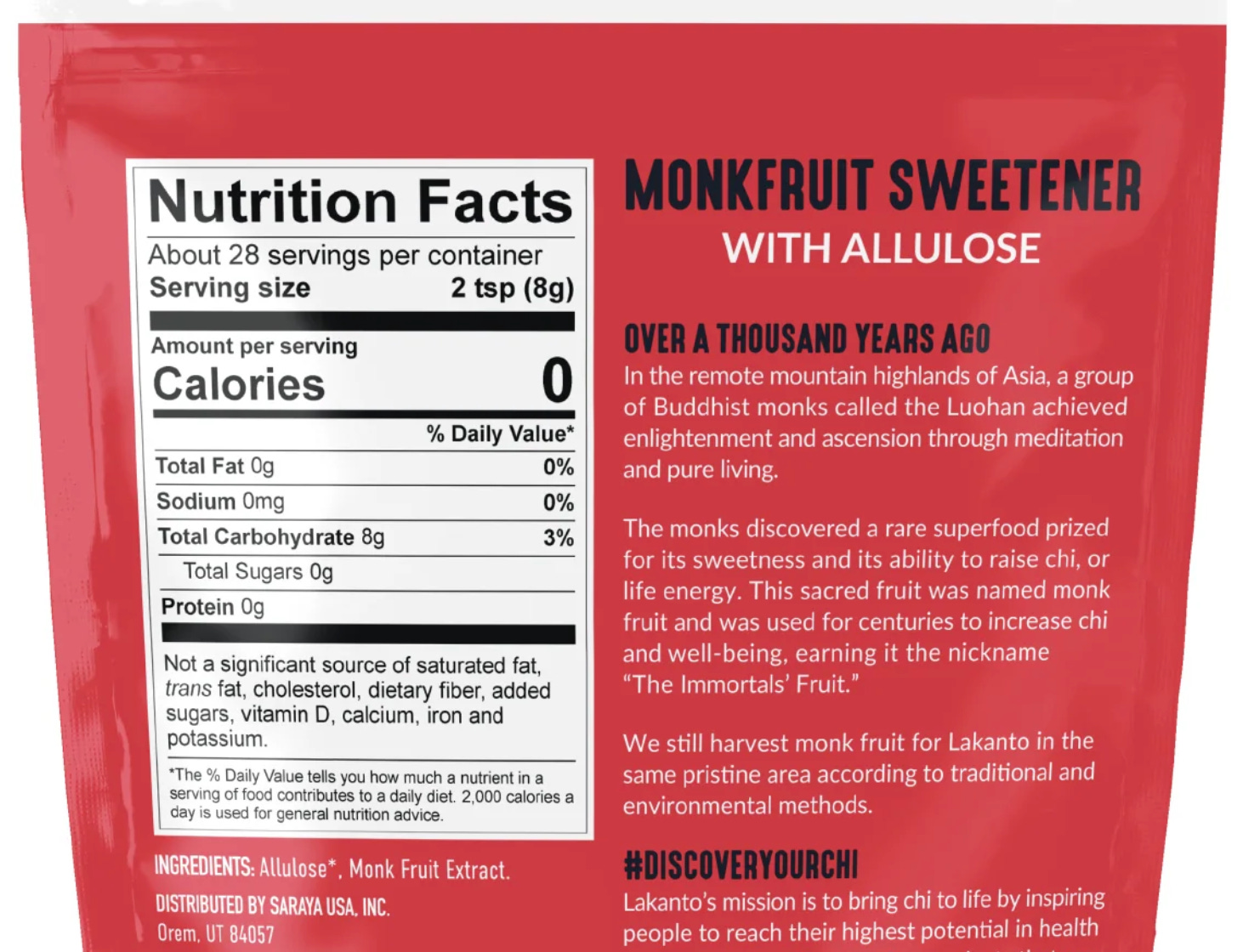
This company’s labeling was somewhat confusing in terms of attempting to navigate net carbs (which their label doesn’t mention), so I asked them for more clarification. Here’s what they said:
“A tablespoon of sweetener with allulose has approximately 12 grams of allulose. We understand that the standard calculation for net carbs does not directly apply to allulose.
Allulose, being a unique sweetener, cannot be separated out in the nutrition facts panel.
To calculate net carbs when allulose is present, simply subtract the grams of allulose from the total carbohydrates listed on the nutrition label, as allulose is not significantly metabolized by the body and therefore does not impact blood sugar levels like other carbohydrates; essentially, you can “exclude” it from your net carb calculation when calculating net carbs.”
With that detail in mind:
Their labeling states that 2 teaspoons of Lakanto Monkfruit Sweetener with Allulose is 0 calories and 8 carbohydrates.
This would mean each teaspoon contains approximately 4 grams of allulose/carbohydrates.
If a tablespoon is 3 teaspoons, then the carbohydrate count for a tablespoon would be 12 grams of allulose/carbohydrates.
This lines up with their confirmation that a tablespoon of this sweetener contains 12 grams of allulose.
In order to easily understand this count in my recipe macros, I have set up my nutrition facts calculator to count 1 Tablespoon of Lakanto Monkfruit Sweetener with Allulose as 0 calories and 0 carbohydrates.
Wholesome Yum/Nature’s Besti
To their credit, Wholesome Yum’s labeling was easy to quickly understand. Their nutrition facts label breaks down the number of carbohydrates in each teaspoon.
Then, just below the nutrition facts, they provide a clear way to get the net carbohydrate count.
2. Wholesome Yum’s Besti Brown Monk Fruit Sweetener with Allulose
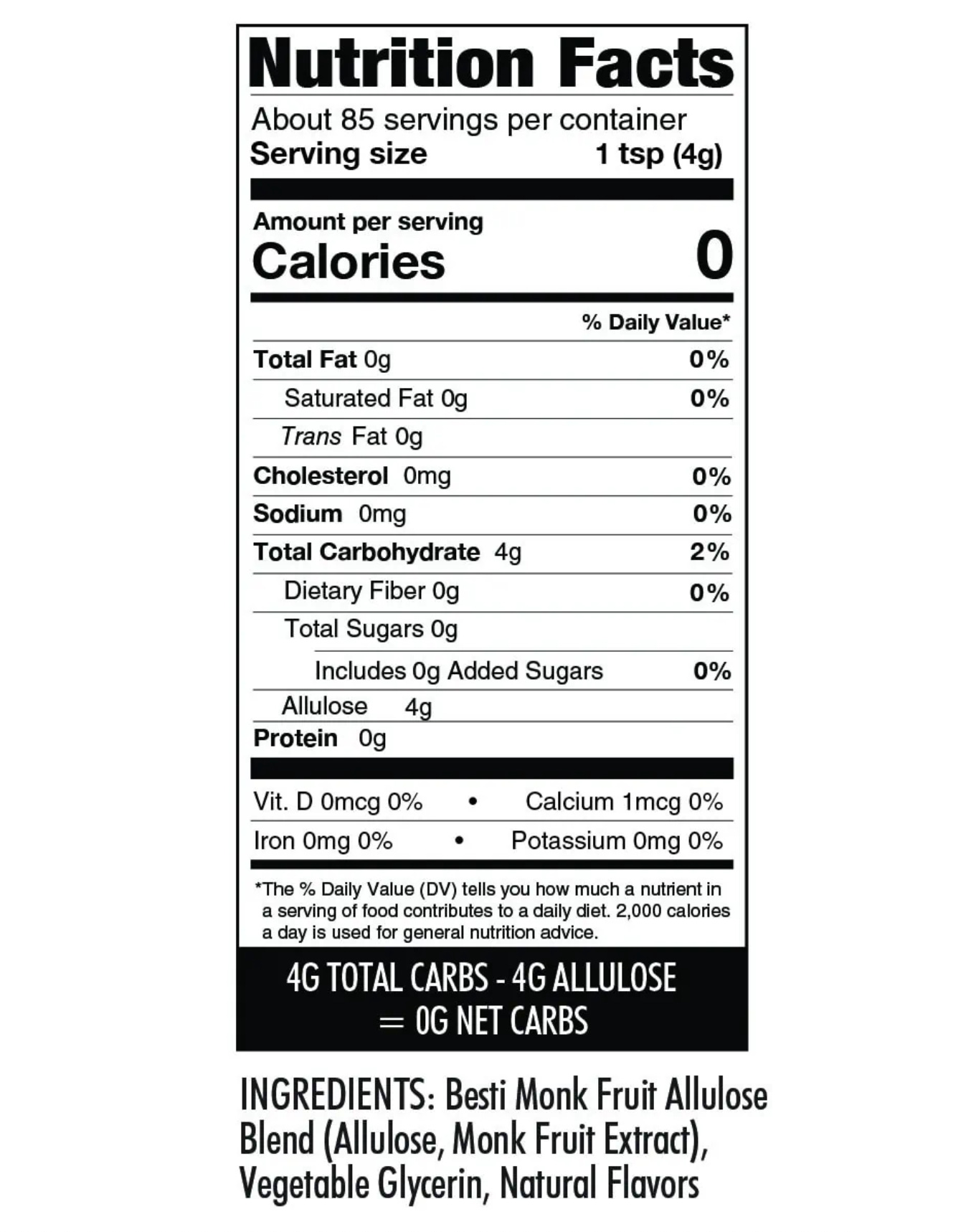
The packaging on their Wholesome Yum’s Besti Brown Monk Fruit Sweetener with Allulose states that 1 teaspoon of this sweetener contains 4 calories and 4 carbohydrates.
The bag then states that 4 Grams of Total Carbs minus 4 grams of allulose = 0 net carbs.
The bag also states that this sweetener is 0 calories and 0 net carbs.
Based on this detail, I have set up my nutrition facts calculator to count 1 Tablespoon of Besti Brown Monk Fruit Sweetener with Allulose as 0 calories and 0 carbohydrates.
3. Wholesome Yum’s Besti Powdered Monk Fruit Sweetener with Allulose
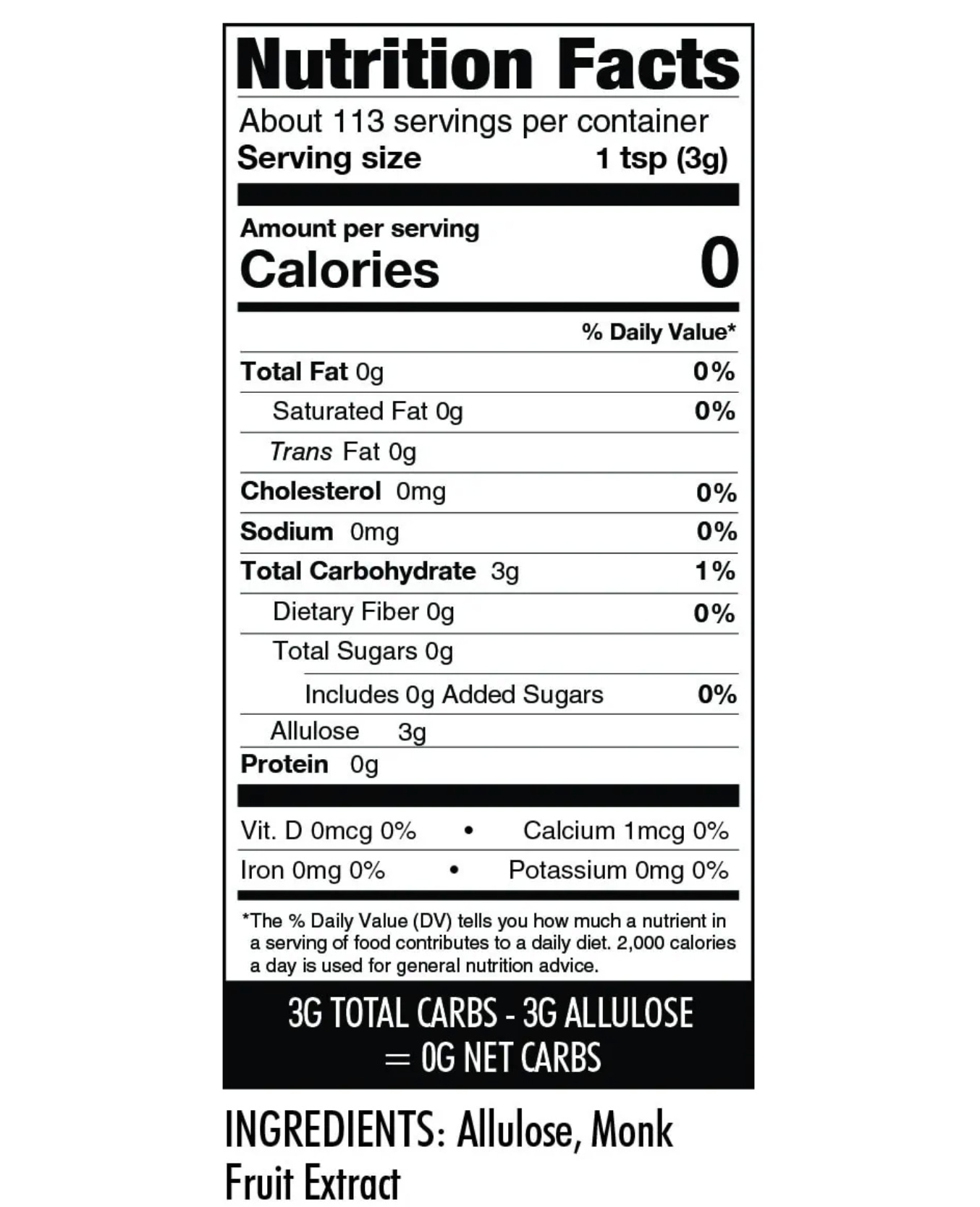
Similarly, the packaging on Wholesome Yum’s Besti Powdered Monk Fruit Sweetener with Allulose states that 1 teaspoon of this sweetener contains 3 calories and 3 carbohydrates.
The bag then states that 3 Grams of Total Carbs minus 3 grams of allulose = 0 net carbs.
The bag also states that this sweetener is 0 calories and 0 net carbs.
So again, with this information in mind, I have set up my nutrition facts calculator to count 1 Tablespoon of Besti Powdered Monk Fruit Sweetener with Alluose as 0 calories and 0 carbohydrates.
This list is evolving as I find time to experiment with additional alternative sweeteners.
If I use a different sweetener in a recipe I share here, I’ll update this article to add the nutrition detail here.
*How I’m calculating the nutrition in each recipe
I’m using the Macro Factor app to automatically calculate nutrition details for the recipes I’m sharing here.
This feature is one of the most helpful parts of the app for someone like me who is always experimenting with recipes and creating new dishes.
It’s very easy to load in all of my ingredients and measurements and the number of servings and have the app calculate the nutrition for each serving.
On top of that, even though many of the ingredients I use in my recipes don’t yet exist in their primary food database, they have a feature that allows me scan the barcode or nutrition facts on a package to create custom food entries.
So this is what I’ve done for the sweeteners I use in order to easily determine the net carb calculations of these recipes, along with any other ingredients that have not yet been added to the database.
Yes, sometimes using a specific brand makes a difference in the macros
I do a fair amount of comparing nutrition labels for ingredients to find brands that make lower sugar options for my ingredients, simply because the grams of sugar can add up quickly in the total count of a recipe.
An example here is that the standard chocolate chips I see on the shelves at my grocery store may have 8-10 grams of carbohydrates and 6-8 grams of sugar for a single serving.
There are sugar free options for chocolate chips and I’ve experimented a bit with those. But I’m not a strictly zero-sugar baker/cook so I’m flexible on this.
I’ll also experiment making the same recipe multiple times using different brand to find the taste or texture that best aligns with my initial vision for the recipe.
So, I was excited to see that Guittard offers a lower sugar chocolate chip called Sante Dark Chocolate Baking Chips that has only 6 grams of carbohydrates and 2 grams of sugar (with the added bonus of 5 grams of fiber) in each serving—and the flavor is also really nice!
Making swaps from the standard chocolate chip to one with macros like this definitely changes things in terms of total sugar or carbohydrate counts in a serving.
So, in cases like this, I will do my best to share the exact products I use myself if I’m using a specific product with macros that contribute to keeping the sugar lower.
If you swap in alternate brands, please note that this may affect the nutritional details of the recipe you make.
I’d also recommend that you calculate the macros independently with the exact brands of ingredients that you choose to cook with to get the most accurate nutrition details for your version of these recipes.
*Unless otherwise noted, all of my nutrition facts are automatically calculated by the MacroFactor app using custom entries for some of the specific brands of ingredients I use.